
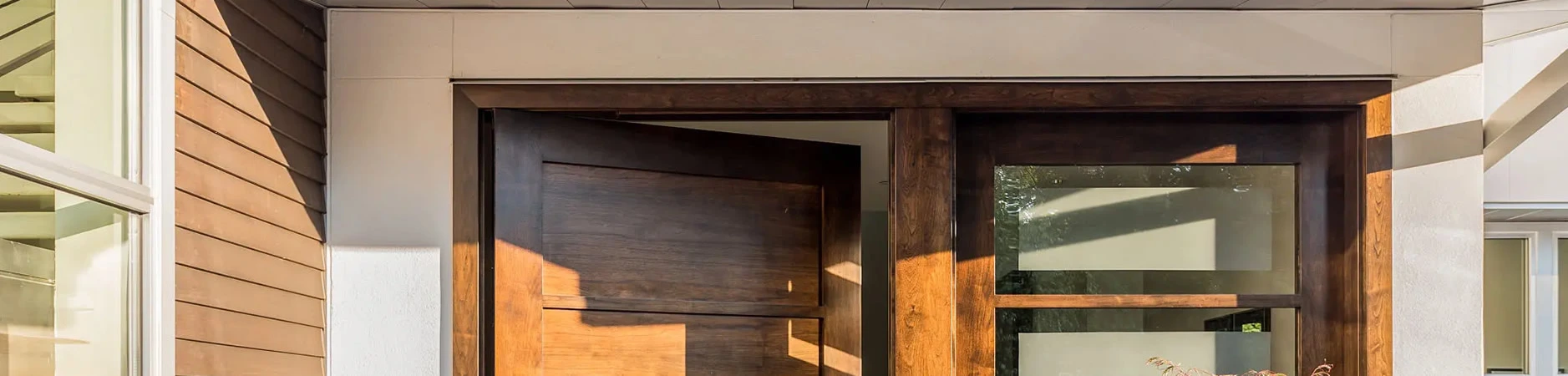
A door is one of the smallest line items on a build and one of the easiest to get wrong on the schedule. Order the wrong configuration and a finish carpenter spends an afternoon mortising hinges and boring locks that should have arrived done — or a slab shows up for an opening that was never framed square. The pre-hung versus slab decision is really a question about your opening, your crew, and your timeline. Here is how to make the call every time.
What is the difference between a pre-hung door and a slab?
A pre-hung door is a complete unit. The slab is already hung on hinges inside a finished jamb, the whole assembly is squared at the mill, and it is usually pre-bored for the lockset and pre-mortised for the strike. You set it in the rough opening, shim it plumb, fasten it, and case it. Exterior pre-hung units add the sill, weatherstrip, and threshold as part of the package.
A slab is the door and nothing else — the bare panel. No jamb, no hinges, no bore unless you order it pre-bored. A slab assumes there is already a sound, square jamb waiting for it.
The two are not competing products. They solve different problems. The mistake is reaching for the cheaper-looking option on the shelf without asking what the opening actually needs.
When should a builder spec pre-hung?
For new construction, pre-hung is the default — and it should be. Use pre-hung whenever:
- The opening is new or framed fresh, so there is no existing jamb to reuse.
- The opening is out of plumb or out of square and the jamb has to do the correcting.
- The crew is setting doors in volume and needs a repeatable, fast install.
- You want the bore, mortise, and reveal handled at the mill instead of on the jobsite.
On a production or custom-home schedule, the value of pre-hung is consistency. Every unit arrives squared and pre-bored, so the install time per door is predictable and the reveals are even down the hall. That predictability is what keeps a trim crew on schedule — which is the whole point.
When is a slab the right call?
A slab earns its place on remodels and one-off swaps. Reach for a slab when:
- You are replacing a single door in an existing jamb that is still plumb and square.
- The casing and frame are staying and only the panel changes — a design upgrade or a damaged-door replacement.
- You are matching an existing, non-standard hinge and lock layout and need to bore to match.
The catch with a slab is that it inherits every flaw in the old jamb. If the existing frame has racked, sagged, or was never square, a new slab will hang as badly as the old one did. Check the jamb for plumb and square before you commit to a slab — if it has moved, you are back to a pre-hung.
Rough opening and jamb sizing — the numbers that matter
Most door problems on a build trace back to a rough opening that was framed without the door spec in hand. Frame to these and the unit drops in clean:
| Door slab width | Rough opening width | Rough opening height (80” door) |
|---|---|---|
| 24” | 26” | ~82.5” |
| 28” | 30” | ~82.5” |
| 30” | 32” | ~82.5” |
| 32” | 34” | ~82.5” |
| 36” | 38” | ~82.5” |
The rule: rough opening width = slab width + 2 inches, and height = door height + about 2 to 2.5 inches measured from the finished subfloor. That extra space is what you shim into to bring the unit plumb and square.
Jamb width matches the wall assembly:
- 4-9/16” jamb — standard 2×4 wall with 1/2” drywall on both faces.
- 6-9/16” jamb — 2×6 wall.
- Custom — thicker walls, double drywall, or plaster. Order the jamb to the wall so the casing lands flush with the drywall and you skip jamb extensions later.
Standard interior slab sizes run 24, 28, 30, 32, and 36 inches wide by 80 inches (6‘8”) tall, with 18, 20, and 22-inch widths common for closets and pantries. If your plan calls for 8-foot doors or non-standard widths, that is an order item, not a stock pull — get it on the schedule early.
How Abel Door & Trim sets you up to win either way
Abel Door & Trim carries both, and the right answer changes with the project — not the supplier. For a volume build, we pre-hang to your spec: the correct jamb width for your wall, the bore and backset your hardware schedule calls for, and the handing marked, so the units land at the jobsite ready to set. For a remodel where the frame stays, we supply the slab cut and bored to match your existing layout, stain-grade or paint-grade to suit the finish.
Big-box doors look cheaper until you add the jamb extension, the hardware prep, and the finish carpenter’s time fixing a frame that was not built for your wall. We pre-hang to your wall and your schedule, so the jobsite work is one clean trip. Every order ships with photo confirmation, so you know the right doors are on the truck before it leaves the yard.
How to set a pre-hung door right
- Confirm the rough opening against the slab size — 2 inches wider, ~2.5 inches taller, plumb studs.
- Set the unit and shim the hinge jamb plumb first. The hinge side carries the weight; get it dead plumb before anything else.
- Check the reveal — aim for a consistent 1/8-inch gap between slab and jamb on the top and latch side.
- Fasten through the jamb into the trimmer studs at each shim, then behind the hinges for solid-core doors.
- Confirm the door swings free and holds position anywhere in its arc before you case it.
This is the verification framework we build every order around: project specs in, takeoff and pre-hang to those specs, install clean, finish confirmed.
Get your doors taken off and pre-hung to spec
Send us your plans and door schedule and we will run the takeoff, match jamb widths to your walls, pre-hang to your hardware spec, and deliver on your build schedule with photo confirmation. Request a takeoff or quote. For more, see our guide to interior door installation for new construction, and our products page for the manufacturers we stock.
Frequently asked questions
What is the difference between a pre-hung door and a slab door?
A pre-hung door is the door slab already mounted on hinges inside a finished jamb, squared and ready to set into a rough opening. A slab is just the door panel — no frame, no hinges, often no bore. Pre-hung is built for new openings; a slab is for re-hanging into an existing jamb that is still plumb and square.
When should a builder use a pre-hung door instead of a slab?
Use pre-hung on new construction and any new or out-of-square opening. The unit arrives plumbed and pre-bored, so a crew sets it in minutes instead of mortising hinges and boring locks by hand. On a production schedule, pre-hung is almost always the faster, more repeatable choice.
When is a slab door the better choice?
Choose a slab when you are replacing a single door in an existing jamb that is still square — a remodel swap, a damaged door, or a design upgrade where the frame and casing stay. A slab also fits non-standard openings where you are matching existing hinge and lock locations.
What size rough opening do I need for a pre-hung interior door?
For a standard pre-hung interior door, frame the rough opening 2 inches wider than the door slab and about 2 to 2.5 inches taller. A 30-inch door needs a 32-inch wide opening; an 80-inch door needs roughly an 82.5-inch opening measured from the subfloor. That gap leaves room to shim plumb and square.
What jamb width do I order for a pre-hung door?
Match the jamb to the wall. A standard 2×4 wall with half-inch drywall both sides takes a 4-9/16-inch jamb. A 2×6 wall takes a 6-9/16-inch jamb. For thicker walls or extra drywall, order a custom jamb width so the casing sits flush — Abel Door & Trim cuts jambs to the wall you are actually building.
Are pre-hung doors more expensive than slabs?
A pre-hung unit costs more on the shelf because it includes the jamb, hinges, and bore. But once you add the labor to mortise hinges, bore a slab, and build a square frame on site, the installed cost of a slab often meets or beats the pre-hung — and takes far longer. On a builder schedule, pre-hung usually wins on total cost.